publications
publications by categories in reversed chronological order.
peer-reviewed journal articles
- Radiotherapy and OncologySamuel Ingram, Lorenzo Brualla, Alexia Delbaere, Masoud Zarepisheh, Hendrik Piersma, Aditya Apte, and 14 more authors
Modern radiotherapy workflows depend heavily on software, yet proprietary solutions limit adaptability and transparency. Many institutions create in-house tools, resulting in duplicated efforts and sustainability challenges. Free and open-source software (FOSS) offers transparency, customization, and collaborative development opportunities, but faces barriers including fragmented efforts, regulatory complexity, and clinical adoption hurdles. This vision paper, inspired by the 2024 ESTRO Physics Workshop on “Resource sharing: open-source software & development in radiotherapy” explores these challenges and proposes strategies to promote sustainable and discoverable open-source ecosystems in radiation oncology. Key recommendations include improving interoperability, clear licensing, risk management, validation frameworks, and creating a centralised registry for resource visibility. Embracing open-source practices can accelerate innovation, reduce redundancy, and enhance patient care.
- J Applied Clin Med PhysShannon Hartzell, Sridhar Yaddanapudi, Keith M. Furutani, Alessio Parisi, Xiaoying Liang, Chunjoo Park, and 7 more authors
Abstract Purpose Modeling relative biological effectiveness (RBE) is central to carbon ion radiotherapy treatment planning. The modified Microdosimetric Kinetic Model (mMKM) is a clinically established RBE framework that has guided treatment protocols at many existing carbon centers, while the Mayo Clinic Florida Microdosimetric Kinetic Model (MCF MKM) is a recently developed alternative. This work aims to implement the MCF MKM in the open‐source treatment planning system matRad and to quantitatively compare its RBE‐weighted dose predictions with those of the clinically established mMKM using identical physical dose distributions across multiple disease sites. These findings will help assess their dosimetric equivalence and inform protocol development for carbon ion radiotherapy at MCF. Methods Monte Carlo simulations of the MCF carbon beamline were performed to generate physical (IDD, LET, lateral spread) and biological base data for integration of each RBE model into matRad . Treatment plans were generated for six patients, each corresponding to a different disease site, using clinical beam configurations with carbon‐reference dose prescriptions, and plans were optimized using the MCF MKM. To isolate differences attributable solely to the RBE model, the resulting physical dose distributions were held fixed and RBE‐weighted doses were recalculated using the mMKM. Dose volume histogram (DVH) metrics and spatial dose‐difference maps were used to compare target coverage and organ‐at‐risk doses between the two models. Results Across patient cases, RBE‐weighted dose distributions from MCF MKM and mMKM showed strong agreement. Differences in target coverage were small, with CTV D95% differing by less than 1.6% across all disease sites and maximum target dose differences not exceeding 0.88%. Organ‐at‐risk dose deviations were limited, with differences of 3.0% or less across evaluated DVH metrics. Spatial dose‐difference maps showed that the largest discrepancies occurred in regions of steep dose gradients near target to organ‐at‐risk interfaces, while overall dose conformity and plan quality remained comparable between the two models. Conclusions: This study served as the first systematic model comparison of the MCF MKM and mMKM within a treatment planning environment. These findings suggest that the MCF MKM and mMKM produce dosimetrically consistent RBE‐weighted dose predictions under realistic planning conditions using carbon‐reference parameters. Accordingly, the fractionation schemes developed from years of clinical experience with mMKM implementations may serve as a practical foundation for protocol development at MCF.
- Med. Phys.Lisa Seckler, Amit Ben Antony Bennan, and Niklas Wahl
As depth increases, linear energy transfer (LET) rises toward the distal edge of the Bragg peak, boosting the radiobiological effectiveness (RBE). To manage the biological variation and limit normal-tissue damage, LET-modifying objective functions on, e.g., dose-weighted LET or dirty dose and/or usage of variable RBE models were introduced. Because shaping LET by proton irradiation alone has its limits, this work proposes to jointly optimize mixed-modality proton-photon treatments based on directly LET-modifying objective functions. The investigated objective functions rely on either dose-weighted LET or dirty dose concepts. To formulate a consistent combined optimization problem, the contribution of secondary electron LET in photon treatments is considered (and discussed) as well. Combined dose/LET calculation and optimization are realized in the open source toolkit matRad. Phantom plans as well as a patient plans are optimized for analysis on the method, combining five proton fractions with 25 photon fractions. Dose-optimized combined plans are used as a reference. The reference plan shows that protons are, in general, dosimetrically superior and thus preferred, with photons aiding in achieving conformity. The introduction of LET modified objectives locally modifies the proton contribution in the targeted regions of interest. Especially at the distal edge, the photon contribution increases to move high-LET/dirty dose out of the OARs. Dirty dose objectives seem to allow a more comprehensive steering of the high-LET regions compared to LETxDose. Incorporating LET-based objectives into a jointly optimized proton-photon system allows for improved dose conformity and reduced high-LET exposure in critical regions in proximity to the distal proton edge. This approach enables the utilization of modality-specific strengths and can contribute to safer, more effective treatment plans.
- Med. Phys.Remo Cristoforetti, Philipp Süss, Tobias Becher, and Niklas Wahl
Background Treatment planning in radiotherapy is inherently a multi-criteria optimization (MCO) problem, as it requires balancing competing clinical goals. Traditionally, the treatment’s robustness is not formulated as a part of this decision making problem, but dealt with separately through margins or robust optimization. Purpose This work facilitates integration of robustness into multi-criteria optimization using a recently proposed efficient “scenario-free” (s-f) robust optimization approach: Utilizing variance reduction objectives, whose computation is independent of the number of chosen error scenarios, robustness can become part of the multi-criteria decision making process at minimal computational overhead. Methods The s-f approach relies on the fast evaluation of the expected dose distribution and mean variance during optimization independent of the scenario number. This is achieved by precomputation of expected dose influence and total variance influence matrices, which can then be used for repeated solving of subproblems in the two explored MCO approaches: Lexicographic Ordering (LO) and full Pareto Front (PF) approximation. Different prioritization strategies within the LO approach are used to assess the impact of variance reduction on the optimization outcome. A 3-objective PF approximation, including a variance reduction objective, is generated to visualize and analyze trade-offs between the competing objectives. The robust optimization is performed including \hskip.001pt 100 scenarios modeling setup and range errors, as well as organ motion, on 3D- and 4DCT lung cancer patient datasets. Robustness analysis is performed to assess and explore the efficacy of all optimization strategies. Results The s-f approach enabled robust optimization in MCO with computational times comparable to nominal MCO. Both MCO strategies highlighted the interplay between dosimetric and variance reduction objectives. The LO approach showed how prioritization affects plan quality and robustness, while the PF analysis revealed a clear trade-off between robustness and organ-at-risk sparing. Conclusions The proposed s-f robust optimization approach allowed the efficient application of robust MCO by significantly reducing the required computational time. The reported analysis highlighted the conflicting trade-off nature of plan robustness and dosimetric quality, demonstrating how robust MCO supports a more informed and flexible decision-making process in treatment planning.
- Phys. Med. Biol.Fan Xiao, Niklas Wahl, Claus Belka, Christopher Kurz, Georgios Dedes, and Guillaume Landry
Objective: Deep learning (DL) methods enable photon dose calculation under two main coordinate representations: Beam’s Eye View (BEV) and patient coordinates. We evaluate dose calculation accuracy and speed under these coordinate paradigms and with representative DL models within a unified dataset and pipeline, and introduce two lightweight models for fast photon dose calculation. Approach: Planning computed tomography (CT) scans and volumetric modulated arc therapy (VMAT) plans from 24 prostate cancer patients were used. Monte Carlo (MC) simulation generated 5940, 540, and 3053 segment doses for training (11 patients), validation (3), and testing (10), respectively. For BEV, we used a combination of convolutional neural network (CNN) and convolutional long short-term memory network (ConvLSTM) called CNN-ConvLSTM, a CNN-Mamba combination (CNN-Mamba), a transformer-based architecture (DoTA), and a cascaded 3D UNet (C3D). These were trained on CT and segment-projection BEV cuboids. For patient coordinates, the DeepDose individual segment dose prediction framework implemented with C3D (DeepDose-C3D) was trained on cropped CT volumes with four physical inputs. Segment and plan dose accuracy were assessed using local gamma passing rates γPR (2%/3 mm and 1%/3 mm) and dose–volume histogram metrics. Dose calculation times (inference plus pre/post-processing) were measured on three different GPUs. Results: All five models achieved mean local γPR values ≥91.0% (2%/3 mm) for segment doses and ≥99.0% (1%/3 mm) for plan doses. Mean per-segment dose calculation times were 79, 67, 298, 490, 356 ms for CNN-ConvLSTM, CNN-Mamba, DoTA, C3D, and DeepDose-C3D, respectively. On the latest-generation GPU avaliable, the corresponding per-plan (average 305 segments) dose calculation times were 5.5, 6.2, 33.6, 38.7 35.4 s. Significance: Both BEV- and patient-coordinate DL methods achieved accurate photon plan dose calculation, with BEV-based approaches showing more robust segment performance. CNN-ConvLSTM and CNN-Mamba retain comparable accuracy at lower computational cost, enabling fast photon dose calculation.
- Med. Phys.Tim Ortkamp, Habiba Sallem, Semi Harrabi, Martin Frank, Oliver Jäkel, Julia Bauer, and 1 more author
In proton therapy of low-grade glioma (LGG) patients, contrast-enhancing brain lesions (CEBLs) on magnetic resonance imaging are considered predictive of late radiation-induced lesions. From the observation that CEBLs tend to concentrate in regions of increased dose-averaged linear energy transfer (LET) and proximal to the ventricular system, the probability of lesion origin (POLO) model has been established as a multivariate logistic regression model for the voxel-wise probability prediction of the CEBL origin. To date, leveraging the predictive power of the POLO model for treatment planning relies on hand tuning the dose and LET distribution to minimize the resulting probability predictions. In this paper, we therefore propose automated POLO model-based treatment planning by directly integrating POLO calculation and optimization into plan optimization for LGG patients. We introduce an extension of the original POLO model including a volumetric correction factor, and a model-based optimization scheme featuring a linear reformulation of the model together with feasible optimization functions based on the predicted POLO values. The developed framework is implemented in the open-source treatment planning toolkit matRad. Our framework can generate clinically acceptable treatment plans while automatically taking into account outcome predictions from the POLO model. It also supports the definition of customized POLO model-based objective and constraint functions. Optimization results from a sample LGG patient show that the POLO model-based outcome predictions can be minimized under expected shifts in dose, LET, and POLO distributions, while sustaining target coverage (\\Delta_{\text{PTV}} \text{d95}_{RBE,fx}≈{0.03} \\Delta_{\text{GTV}} \text{d95}_{RBE,fx}≈{0.001}\), even at large NTCP reductions of \∆{\text{NTCP}}≈{26}\%\.
- JCPPia Stammer, Niklas Wahl, Jonas Kusch, and Danny Lathouwers
Dose calculations in proton therapy require the fast and accurate solution of a high-dimensional transport equation for a large number of (pencil) beams with different energies and directions. Deterministically solving this transport problem at a sufficient resolution can however be prohibitively expensive, especially due to highly forward peaked scattering of the protons. We propose using a model order reduction approach, the dynamical low-rank approximation (DLRA), which evolves the solution on the manifold of low-rank matrices in (pseudo-)time. For this, we compare a collided-uncollided split of the linear Boltzmann equation and its Fokker-Planck approximation. We treat the uncollided part using a ray-tracer and combine high-order phase space discretizations and a mixture model for materials with DLRA for the collided equation. Our method reproduces the results of a full-rank reference code at significantly lower rank, and thus computational cost and memory, and further makes computations feasible at much higher resolutions. At higher resolutions, we also achieve good accuracy with respect to TOPAS MC in homogeneous as well as heterogeneous materials. Finally, we demonstrate that several beam sources with different angles can be computed with little cost increase compared to individual beams.
- Med. Phys.Jennifer Josephine Hardt, Alexander A. Pryanichnikov, Oliver Jäkel, Joao Seco, and Niklas Wahl
BackgroundRecently, mixed carbon–helium beams were proposed for range verification in carbon ion therapy: helium, with three times the range of carbon, serves as an online range probe and is mixed into a therapeutic carbon beam. PurposeTreatment monitoring is of special interest for lung cancer therapy; however, the helium range might not always be sufficient to exit the patient distally. Therefore, mixed beam use cases of several patient sites are considered. MethodsAn extension to the open-source planning toolkit, matRad, allows for calculation and optimization of mixed beam treatment plans. The use of the mixed beam method in 15 patients with lung cancer, as well as in a prostate and liver case, for various potential beam configurations was investigated. Planning strategies to optimize the residual helium range considering the sensitive energy range of the imaging detector were developed. A strategy involves adding helium to energies whose range is sufficient. Another one is to use range shifters to increase the beam energy and thus helium range. ResultsIn most patient cases, the residual helium range of at least one spot is too low. All investigated planning strategies can be used to ensure a high enough helium range while still keeping a low helium dose and a satisfactory total mixed carbon–helium beam dose. The use of range shifters allows for the detection of more spots. ConclusionThe mixed beam method shows promising results for online monitoring. The use of range shifters ensures a high enough helium range and more detectable spots, allowing for a wider-spread application.
- Med. Phys.Fan Xiao, Domagoj Radonic, Niklas Wahl, Nikolaos Delopoulos, Adrian Thummerer, Stefanie Corradini, and 4 more authors
Background In magnetic resonance imaging (MRI)-guided online adaptive radiotherapy, MRI lacks tissue attenuation information necessary for accurate dose calculations. Although deep learning (DL)-based synthetic computed tomography (CT) generation models have been developed to obtain CT density information from MRI, they usually do not meet the requirement of real-time plan adaptation. Purpose We propose a DL-based photon dose calculation method directly on 0.35 T MRI to skip synthetic CT generation and show its feasibility for prostate patient cases. Methods The 0.35 T planning MRI and deformed planning CT (registered to the planning MRI) of 34 prostate cancer patients treated with a 0.35 T magnetic resonance-linear accelerator (MR-Linac) were collected. The air cavities (ACs) in the abdominopelvic area of the deformed CT images were corrected based on manual AC contouring on the MRI. Monte Carlo (MC) dose simulations under a 0.35 T magnetic field were performed on the corrected CT images. All photon beams were simulated using a uniform field size of \1\,\textcm \times 1\,\textcm\. 10 800 beams were simulated with \5\times 10^6 initial photons for training (20 patients) and 2160 beams with \5\times 10^7 photons for validation (4 patients). For testing, 1080 beams shooting through the planning target volume (PTV) in 10 patients and five optimized nine-field intensity-modulated plans were simulated with \5\times 10^7 photons. 3D MRI cuboids covering the photon beams were input into a Unet model to predict AC segmentation, and 3D MRI and predicted AC cuboids were input into a long short-term memory (LSTM) model for beam’s eye view (BEV) processing to predict dose. The gamma passing rate γ_\mathrmpr (2%/2mm, \D>10%D_\mathrmmax\), beam dose profiles of single beams and dose volume histogram (DVH) of intensity-modulated plans were evaluated. Results The test results for all photon beams from the proposed models demonstrated a mean γ_\mathrmpr above 99.50%. The five treatment plans recalculated by the DL model each achieved γ_\mathrmpr values exceeding 99.80%. Additionally, the model’s inference time was approximately 12 ms per photon beam. Conclusions The proposed method showed that DL-based dose calculation directly on MRI is feasible for prostate cases, which has the potential to simplify the procedure for MRI-only workflows and can be beneficial for real-time plan adaptation.
- Biomed. Phys. Eng. ExpressLucas Sommer, Tobias Chemnitz, Niklas Wahl, Amit B A Bennan, Stephanie E Combs, and Jan J Wilkens
Objective: The purpose of the work presented here was to enable easy access to Monte Carlo dose calculation for both fast neutron therapy and boron neutron capture therapy for research purposes. The dose calculation approach was especially intended to hold high customization potential for individual user applications. Approach: The dose engine is based on the Monte Carlo code MCNP. It is integrated into the MATLAB-based open source research treatment planning software matRad as modular component. Main results: Total dose calculation is enabled for both fast neutron therapy and boron neutron capture therapy on patient CT data. The evaluation of the dose distribution is possible using the matRad graphical user interface and dose volume histograms. Customization options are provided for advanced users. Significance: The open source treatment planning software allows easy access to highly accurate Monte Carlo dose calculation for research projects.
- Med. Phys.SynthRAD2025 Grand Challenge dataset: Generating synthetic CTs for radiotherapy from head to abdomenAdrian Thummerer, Erik Van Der Bijl, Arthur Jr Galapon, Florian Kamp, Mark Savenije, Christina Muijs, and 13 more authors
Abstract Purpose Medical imaging is crucial in modern radiotherapy, aiding diagnosis, treatment planning, and monitoring. The development of synthetic imaging techniques, particularly synthetic computed tomography (sCT), continues to attract interest in radiotherapy. The SynthRAD2025 dataset and the accompanying SynthRAD2025 Grand Challenge aim to stimulate advancements in synthetic CT generation algorithms by providing a platform for comprehensive evaluation and benchmarking of synthetic CT generation algorithms based on cone‐beam CTs (CBCT) and magnetic resonance images (MRI). Acquisition and validation methods The dataset comprises 2362 cases, including 890 MRI‐CT pairs and 1472 CBCT‐CT pairs of head‐and‐neck, thoracic, and abdominal cancer patients treated at five European university medical centers [UMC Groningen, UMC Utrecht, Radboud UMC (Netherlands), LMU University Hospital Munich, and University Hospital of Cologne (Germany)]. Images were acquired using a wide range of acquisition protocols and scanners. Pre‐processing, including rigid and deformable image registration methods, was performed to ensure high‐quality image datasets and alignment between modalities. Extensive quality assurance was performed to validate image consistency and usability. Data format and usage notes All imaging data is provided using the MetaImage (.mha) file format, ensuring compatibility with common medical image processing tools. Metadata, including acquisition parameters and registration details, is available in structured comma‐separated value (CSV) files. To ensure dataset integrity, SynthRAD2025 is split into training (65%), validation (10%), and test (25%) sets. The dataset is accessible through https://doi.org/10.5281/zenodo.14918088 under the SynthRAD2025 collection. Potential applications This dataset enables benchmarking and development of synthetic imaging techniques for radiotherapy applications. Potential use cases include sCT generation for MRI‐only and MR‐guided photon and proton radiotherapy, CBCT‐based dose calculations, and adaptive radiotherapy workflows. By incorporating data from diverse acquisition settings, SynthRAD2025 supports the advancement of robust and generalizable image synthesis algorithms for clinical implementation, ultimately promoting personalized cancer care and improving adaptive radiotherapy workflows.
- Phys. Med. Biol.Damian Borys, Jan Gajewski, Tobias Becher, Yair Censor, Renata Kopec, Marzena Rydygier, and 6 more authors
GPU-accelerated FREDopt package for simultaneous dose and LETd proton radiotherapy plan optimization via superiorization methods, Borys, Damian, Gajewski, Jan, Becher, Tobias, Censor, Yair, Kopec, Renata, Rydygier, Marzena, Schiavi, Angelo, Skóra, Tomasz, Spaleniak, Anna, Wahl, Niklas, Wochnik, Agnieszka, Rucinski, Antoni
- Med. Phys.Remo Cristoforetti, Jennifer Josephine Hardt, and Niklas Wahl
Robust treatment planning algorithms for Intensity Modulated Proton Therapy (IMPT) and Intensity Modulated Radiation Therapy (IMRT) allow for uncertainty reduction in the delivered dose distributions through explicit inclusion of error scenarios. Due to the curse of dimensionality, application of such algorithms can easily become computationally prohibitive. This work proposes a scenario-free probabilistic robust optimization algorithm that overcomes both the runtime and memory limitations typical of traditional robustness algorithms. The scenario-free approach minimizes cost-functions evaluated on expected-dose distributions and total variance. Calculation of these quantities relies on precomputed expected-dose-influence and total-variance-influence matrices, such that no scenarios need to be stored for optimization. The algorithm was developed within matRad and tested in several optimization configurations for photon and proton irradiation plans. A traditional robust optimization algorithm and a margin-based approach are used as a reference to benchmark the performances of the scenario-free algorithm in terms of plan quality, robustness and computational workload. The scenario-free approach achieves plan quality compatible with traditional robust optimization algorithms and it reduces the standard deviation within selected structures when variance reduction objectives are defined. Avoiding the storage of individual scenario information allows for the inclusion of an arbitrary number of error scenarios. The observed optimization time is independent on the number of included scenarios, compatible with a nominal, non-robust algorithm and significantly lower than the traditional robust approach. These properties make the scenario-free approach suitable for the optimization of robust plans involving a high number of error scenarios and CT phases as 4D robust optimization.
- Physica MedicaAlexander A. Pryanichnikov, Jennifer J. Hardt, Ethan A. DeJongh, Lukas Martin, Don F. DeJongh, Oliver Jäkel, and 2 more authors
Purpose This study aims to evaluate the feasibility of using fast, low-dose proton (pRad) and helium (HeRad) radiography for intrafractional motion management. This approach uses pencil ion beam delivery systems, modern particle imaging detectors and fast image reconstruction. Methods A plastic respiratory phantom underwent four-dimensional computed tomography (4DCT) using a commercial X-ray scanner, experimental pRad with a continuous proton beam from a clinical serial cyclotron, and experimental pRad and HeRad with pulsed proton and helium beams from a synchrotron-based ion therapy facility. Open-source patient 4DCT data were used in a Monte Carlo simulation study to evaluate pRad and HeRad in a realistic patient geometry. Treatment plans involving mixed carbon-helium beams were calculated using matRad and simulated in TOPAS. Results The experimental pRad achieved a temporal resolution of 8 fps for the cyclotron-based facility, while both pRad and HeRad achieved 2 fps for the synchrotron-based facility within a 10 cm × 10 cm region of interest. pRad reconstructed the respiratory phantom motion pattern with a dose of less than 2 µGy per image. In simulations of mixed carbon-helium beams, HeRad, both integral and single iso-energy, detected water equivalent thickness differences with sub-millimeter accuracy across different phases of the patient’s 4DCT data. Conclusion This study demonstrates that low-dose small-field proton and helium radiography, utilizing pencil beam scanning, can effectively monitor intrafractional anatomical displacements with millimeter-level spatial accuracy and sub-second temporal resolution. Current particle imaging and beam delivery technologies have the potential to enable real-time patient monitoring in promising mixed ion beam therapy.
- Med. Phys.Andrés C. Sevilla, Gonzalo Cabal, Niklas Wahl, María E. Puerta, and Juan C. Rivera
Background Over the past three decades, the intensity-modulated radiotherapy (IMRT) has become a standard technique, enabling highly conformal dose distributions tailored to specific clinical objectives. Despite these advancements, IMRT treatment plans are significantly susceptible to uncertainties during both the planning and delivery phases. The most commonly used strategy to address these uncertainties is the margin-based or planning target volume (PTV) approach, which relies on the so-called dose cloud approximation. However, the PTV concept has notable limitations, particularly in complex scenarios where target volumes are superficial or located near critical structures. In contrast, the advent of intensity-modulated particle therapy has driven the development of robust optimization models, which have emerged as a promising alternative for managing uncertainties. Among these, the worst-case scenario or minimax strategy is the most widely employed. While minimax can be directly applied to photon treatments, its use in IMRT often leads to overly conservative plans or plans that are very similar to those obtained using the conventional margin-based PTV approach. Purpose In this work, we present a robust optimization model particularly suitable for photon treatments. The new approach, called Cheap-Minimax, is a generalization of the minimax strategy used for particle therapy and aims to improve the balance between plan robustness and the price of robustness in terms of dose to organs at risk (OARs), an issue particularly pronounced in photon treatments. Methods The c-minimax model was implemented in the MatRad treatment planning system, developed at the German Cancer Research Center (DKFZ). It was applied to 20 clinical cases, comprising 5 prostate cancer cases and 15 breast cancer cases. The results were compared with those obtained using the conventional minimax model and the PTV-based approach. Results For prostate cancer cases, the c-minimax model maintained a robustness comparable to the PTV approach, while achieving a 20% reduction in V40Gy\V_40 \textGy for the rectum and a 10% reduction in V60Gy\V_60 \textGy for the bladder compared to the minimax model. In breast cancer cases, the c-minimax model improved robustness by 23.7% relative to the PTV approach and by 18.2% compared to the minimax model. Additionally, the c-minimax model reduced V20Gy\V_20 \textGy for the ipsilateral lung by 3.7% and the mean heart dose by 1.2 Gy (20%) compared to minimax. Both the c-minimax and minimax models reduced D5%\D_5% skin dose by 10.9 Gy (18.9%) and 11.1 Gy (19.3%), respectively, compared to the PTV approach. Conclusions The c-minimax model successfully overcomes the limitations of the PTV approach and the over-conservativeness of the minimax model, demonstrating significant advantages in managing uncertainties in complex cases, such as breast cancer. By providing superior robustness compared to PTV and reducing OAR doses relative to minimax, the model offers a flexible and clinically feasible strategy to enhance treatment quality. The marked reduction in high-dose regions (hotspots) in superficial tissues and skin highlights its potential to lower toxicity risks and improve patient outcomes. These results provide quantitative evidence of the practical benefits of robustness-compromise-oriented approaches in IMRT.
- CancersAndrés Camilo Sevilla-Moreno, María Eugenia Puerta-Yepes, Niklas Wahl, Rafael Benito-Herce, and Gonzalo Cabal-Arango
Background: Cancer remains one of the leading causes of mortality worldwide, with radiotherapy playing a crucial role in its treatment. Intensity-modulated radiotherapy (IMRT) enables precise dose delivery to tumors while sparing healthy tissues. However, geometric uncertainties such as patient positioning errors and anatomical deformations can compromise treatment accuracy. Traditional methods use safety margins, which may lead to excessive irradiation of healthy organs or insufficient tumor coverage. Robust optimization techniques, such as minimax approaches, attempt to address these uncertainties but can result in overly conservative treatment plans. This study introduces an interval analysis-based optimization model for IMRT, offering a more flexible approach to uncertainty management. Methods: The proposed model represents geometric uncertainties using interval dose influence matrices and incorporates Bertoluzza’s metric to balance tumor coverage and organ-at-risk (OAR) protection. The θ parameter allows controlled robustness modulation. The model was implemented in matRad, an open-source treatment planning system, and evaluated on five prostate cancer cases. Results were compared against traditional Planning Target Volume (PTV) and minimax robust optimization approaches. Results: The interval-based model improved tumor coverage by 5.8% while reducing bladder dose by 4.2% compared to PTV. In contrast, minimax robust optimization improved tumor coverage by 25.8% but increased bladder dose by 23.2%. The interval-based approach provided a better balance between tumor coverage and OAR protection, demonstrating its potential to enhance treatment effectiveness without excessive conservatism. Conclusions: This study presents a novel framework for IMRT planning that improves uncertainty management through interval analysis. By allowing adjustable robustness modulation, the proposed model enables more personalized and clinically adaptable treatment plans. These findings highlight the potential of interval analysis as a powerful tool for optimizing radiotherapy outcomes, balancing treatment efficacy and patient safety.
- Med. Phys.Mateusz Sitarz, Maria Grazia Ronga, Flavia Gesualdi, Anthony Bonfrate, Niklas Wahl, and Ludovic De Marzi
Background While electron beams of up to 20 MeV are commonly used in radiotherapy, the use of very-high-energy electrons (VHEEs) in the range of 100–200 MeV is now becoming a realistic option thanks to the recent advancements in accelerator technology. Indeed, VHEE offers several clinically attractive features and can be delivered using various conformation methods (including scanning, collimation, and focussing) at ultra-high dose rates. To date, there is a lack of research tools for fast simulation of treatment plans using VHEE beams. Purpose This work aims to implement and validate a simple and fast dose calculation algorithm based on the Fermi–Eyges theory of multiple Coulomb scattering for VHEE radiation therapy, with energies up to 200 MeV. A treatment planning system (TPS) toolkit with VHEE modality would indeed allow for further preclinical investigations, including treatment plan optimization and evaluation, and thus contribute to the gradual introduction of VHEE radiotherapy in clinical practice. Methods A VHEE pencil beam scanning double Gaussian model was introduced into the open-source TPS matRad environment along with new functions and options dedicated to VHEE dose calculations. Various geometries and field configurations were then calculated in matRad (up to 200 MeV and 15 × 15 cm2, with complex bone or lung heterogeneities) and the results were compared to Monte Carlo simulations in the TOPAS/Geant4 toolkit. Two types of beam model (divergent or focused) were also tested. Examples of clinical treatment plans were computed, and the results were compared between the two codes. Results VHEE modality was fully implemented in matRad with GUI capabilities while preserving all original TPS features. New relevant options such as the importation of specific spot-lists or adjustment of the lateral dose calculation cutoff to optimize the calculation speed were validated. Single spot and square field dose distributions were validated in water alone as well as in clinically relevant inhomogeneities. Dose maps from the VHEE model in matRad were in good agreement with TOPAS (2D gamma index [2%/1 mm] with passing rates superior to 90%, <6% mean dose differences), except for large interface heterogeneities. Conclusions This work describes the implementation of a simple but efficient VHEE simulation model in matRad. A few configurations were studied in order to validate the model against accurate Monte Carlo simulations, demonstrating its usefulness for carrying out preliminary studies involving VHEE radiotherapy.
- Phys. Med. Biol.Fan Xiao, Domagoj Radonic, Michael Kriechbaum, Niklas Wahl, Ahmad Neishabouri, Nikolaos Delopoulos, and 6 more authors
Objective: To present a long short-term memory (LSTM)-based prompt gamma (PG) emission prediction method for proton therapy. Approach: Computed tomography (CT) scans of 33 patients with a prostate tumor were included in the dataset. A set of 10 million histories proton pencil beam (PB)s was generated for Monte Carlo (MC) dose and PG simulation. For training (20 patients) and validation (3 patients), over 6000 PBs at 150, 175 and 200 MeV were simulated. 3D relative stopping power (RSP), PG and dose cuboids that included the PB were extracted. Three models were trained, validated and tested based on an LSTM-based network: (1) input RSP and output PG, (2) input RSP with dose and output PG (single-energy), and (3) input RSP/dose and output PG (multi-energy). 540 PBs at each of the four energy levels (150, 175, 200, and 125-210 MeV) were simulated across 10 patients to test the three models. The gamma passing rate (2%/2mm) and PG range shift were evaluated and compared among the three models. Results: The model with input RSP/dose and output PG (multi-energy) showed the best performance in terms of gamma passing rate and range shift metrics. Its mean gamma passing rate of testing PBs of 125-210 MeV was 98.5% and the worst case was 92.8%. Its mean absolute range shift between predicted and MC PGs was 0.15 mm, where the maximum shift was 1.1mm. The prediction time of our models was within 130 ms per PB. Significance: We developed a sub-second LSTM-based PG emission prediction method. Its accuracy in prostate patients has been confirmed across an extensive range of proton energies.
- Phys. Med. Biol.Domagoj Radonic, Fan Xiao, Niklas Wahl, Luke Voss, Ahmad Neishabouri, Nikolaos Delopoulos, and 6 more authors
Objective: To present a long short-term memory (LSTM) network-based dose calculation method for magnetic resonance (MR)-guided proton therapy. Approach: 35 planning computed tomography (CT) images of prostate cancer patients were collected for Monte Carlo (MC) dose calculation under a perpendicular 1.5 T magnetic field. Proton pencil beams (PB) at three energies (150, 175, and 200 MeV) were simulated (7560 PBs at each energy). A 3D relative stopping power (RSP) cuboid covering the extent of the PB dose was extracted and given as input to the LSTM model, yielding a 3D predicted PB dose. Three single-energy (SE) LSTM models were trained separately on the corresponding 150/175/200 MeV datasets and a multi-energy (ME) LSTM model with an energy embedding layer was trained on either the combined dataset with three energies or a continuous energy (CE) dataset with 1 MeV steps ranging from 125 to 200 MeV. For each model, training and validation involved 25 patients and 10 patients were for testing. Two single field uniform dose prostate treatment plans were optimized and recalculated with MC and the CE model. Results: Test results of all PBs from the three SE models showed a mean gamma passing rate (2%/2mm, 10% dose cutoff) above 99.9% with an average center-of-mass (COM) discrepancy below 0.4 mm between predicted and simulated trajectories. The ME model showed a mean gamma passing rate exceeding 99.8% and a COM discrepancy of less than 0.5 mm at the three energies. Treatment plan recalculation by the CE model yielded gamma passing rates of 99.6% and 97.9%. The inference time of the models was 9-10 ms per PB. Significance: LSTM models for proton dose calculation in a magnetic field were developed and showed promising accuracy and efficiency for prostate cancer patients.
- IJROBPNathan Harrison, Minglei Kang, Ruirui Liu, Serdar Charyyev, Niklas Wahl, Wei Liu, and 6 more authors
- Phys. Med. Biol.Jennifer J Hardt, Alexander A Pryanichnikov, Noa Homolka, Ethan A DeJongh, Don F DeJongh, Remo Cristoforetti, and 3 more authors
Objective: Recently, a new and promising approach for range verification was proposed. This method requires the use of two different ion species. Due to their equal magnetic rigidity, fully ionized carbon and helium ions can be simultaneously accelerated in accelerators like synchrotrons. At sufficiently high treatment energies, helium ions can exit the patient distally, reaching approximately three times the range of carbon ions at an equal energy per nucleon. Therefore, the proposal involves adding a small helium fluence to the carbon ion beam and utilizing helium as an online range probe during radiation therapy. This work aims to develop a software framework for treatment planning and motion verification in range-guided radiation therapy using mixed carbon-helium beams. Approach: The developed framework is based on the open-source treatment planning toolkit matRad. Dose distributions and helium radiographs were simulated using the open-source Monte Carlo package TOPAS. Beam delivery system parameters were obtained from the Heidelberg Ion Therapy Center, and imaging detectors along with reconstruction were facilitated by ProtonVDA. Methods for reconstructing the most likely patient positioning error scenarios and the motion phase of 4DCT are presented for prostate and lung cancer sites. Main results: The developed framework provides the capability to calculate and optimize treatment plans for mixed carbon-helium ion therapy. It can simulate the treatment process and generate helium radiographs for simulated patient geometry, including small beam views. Furthermore, motion reconstruction based on these radiographs seems possible with preliminary validation. Significance: The developed framework can be applied for further experimental work with the promising mixed carbon-helium ion implementation of range-guided radiotherapy. It offers opportunities for adaptation in particle therapy, improving dose accumulation, and enabling patient anatomy reconstruction during radiotherapy.
- Med. Phys.Bruce Faddegon, Martina Descovich, Katherine Chen, José Ramos-Méndez, Mack Roach, Niklas Wahl, and 3 more authors
Background Daily IGRT images show day-to-day anatomical variations in patients undergoing fractionated prostate radiotherapy. This is of particular importance in particle beam treatments. Purpose To develop a digital phantom series showing variation in pelvic anatomy for evaluating treatment planning and IGRT procedures in particle radiotherapy. Methods A pelvic phantom series was developed from the planning MRI and kVCT (planning CT) images along with six of the daily serial MVCT images taken of a single patient treated with a full bladder on a Tomotherapy unit. The selected patient had clearly visible yet unexceptional internal anatomy variation. Prostate, urethra, bladder, rectum, bowel, bowel gas, bone and soft tissue were contoured and a single Hounsfield Unit was assigned to each region. Treatment plans developed on the kVCT for photon, proton and carbon beams were recalculated on each phantom to demonstrate a clinical application of the series. Proton plans were developed with and without robust optimization. Results Limited to axial slices with prostate, the bladder volume varied from 6 to 46 cm3, the rectal volume (excluding gas) from 22 to 52 cm3, and rectal gas volume from zero to 18 cm3. The water equivalent path length to the prostate varied by up to 1.5 cm . The variations resulted in larger changes in the RBE-weighted Dose Volume Histograms of the non-robust proton plan and the carbon plan compared to the robust proton plan, the latter similar to the photon plan. The prostate coverage (V100%) decreased by an average of 18% in the carbon plan, 16% in the non-robust proton plan, 1.8% in the robust proton plan, and 4.4% in the photon plan. The volume of rectum receiving 75% of the prescription dose (V75%) increased by an average of 3.7 cm3, 4.7 cm3, 1.9 cm3, and 0.6 cm3 in those four plans, respectively. Conclusions The digital pelvic phantom series provides for quantitative investigation of IGRT procedures and new methods for improving accuracy in particle therapy and may be used in cross-institutional comparisons for clinical trial quality assurance.
- StatsFlavia Gesualdi and Niklas Wahl
In radiotherapy treatment planning, the absorbed doses are subject to executional and preparational errors, which propagate to plan quality metrics. Accurately quantifying these uncertainties is imperative for improved treatment outcomes. One approach, analytical probabilistic modeling (APM), presents a highly computationally efficient method. This study evaluates the empirical distribution of dose–volume histogram points (a typical plan metric) derived from Monte Carlo sampling to quantify the accuracy of modeling uncertainties under different distribution assumptions, including Gaussian, log-normal, four-parameter beta, gamma, and Gumbel distributions. Since APM necessitates the bivariate cumulative distribution functions, this investigation also delves into approximations using a Gaussian or an Ali–Mikhail–Haq Copula. The evaluations are performed in a one-dimensional simulated geometry and on patient data for a lung case. Our findings suggest that employing a beta distribution offers improved modeling accuracy compared to a normal distribution. Moreover, the multivariate Gaussian model outperforms the Copula models in patient data. This investigation highlights the significance of appropriate statistical distribution selection in advancing the accuracy of uncertainty modeling in radiotherapy treatment planning, extending an understanding of the analytical probabilistic modeling capacities in this crucial medical domain.
- Phys. Med. Biol.Yang Han, Changran Geng, Saverio Altieri, Silva Bortolussi, Yuanhao Liu, Niklas Wahl, and 1 more author
Objective: Boron neutron capture therapy (BNCT) and carbon ion radiotherapy (CIRT) are emerging treatment modalities for glioblastoma. In this study, we investigated the methodology and feasibility to combine BNCT and CIRT treatments. The combined treatment plan illustrated how the synergistic utilization of BNCT’s biological targeting and CIRT’s intensity modulation capabilities could lead to optimized treatment outcomes. Approach: The Monte Carlo toolkit, TOPAS, was employed to calculate the dose distribution for BNCT, while matRad was utilized for the optimization of CIRT. The biological effect-based approach, instead of the dose-based approach, was adopted to develop the combined BNCT-CIRT treatment plans for six patients diagnosed with glioblastoma, considering the different radiosensitivity and fraction. Five optional combined treatment plans with specific BNCT effect proportions for each patient were evaluated to identify the optimal treatment that minimizes damage on normal tissue. Main results: Individual BNCT exhibits a significant effect gradient along with the beam direction in the large tumor, while combined BNCT-CIRT treatments can achieve uniform effect delivery within the CTV through the effect filling with reversed gradient by the CIRT part. In addition, the increasing BNCT effect proportion in combined treatments can reduce damage in the normal brain tissue near the CTV. Besides, the combined treatments effectively minimize damage to the skin compared to individual BNCT treatments. Significance: The initial endeavor to combine BNCT and CIRT treatment plans is achieved by the effect-based optimization. The observed advantages of the combined treatment suggest its potential applicability for tumors characterized by pleomorphic, infiltrative, radioresistant and voluminous features.
- Front. Oncol.Florian Barkmann, Yair Censor, and Niklas Wahl
ObjectiveWe apply the superiorization methodology to the constrained intensity-modulated radiation therapy (IMRT) treatment planning problem. Superiorization combines a feasibility-seeking projection algorithm with objective function reduction: The underlying projection algorithm is perturbed with gradient descent steps to steer the algorithm towards a solution with a lower objective function value compared to one obtained solely through feasibility-seeking.ApproachWithin the open-source inverse planning toolkit matRad, we implement a prototypical algorithmic framework for superiorization using the well-established Agmon, Motzkin, and Schoenberg (AMS) feasibility-seeking projection algorithm and common nonlinear dose optimization objective functions. Based on this prototype, we apply superiorization to intensity-modulated radiation therapy treatment planning and compare it with (i) bare feasibility-seeking (i.e., without any objective function) and (ii) nonlinear constrained optimization using first-order derivatives. For these comparisons, we use the TG119 water phantom, the head-and-neck and the prostate patient of the CORT dataset.Main resultsBare feasibility-seeking with AMS confirms previous studies, showing it can find solutions that are nearly equivalent to those found by the established piece-wise least-squares optimization approach. The superiorization prototype solved the linearly constrained planning problem with similar dosimetric performance to that of a general-purpose nonlinear constrained optimizer while showing smooth convergence in both constraint proximity and objective function reduction.SignificanceSuperiorization is a useful alternative to constrained optimization in radiotherapy inverse treatment planning. Future extensions with other approaches to feasibility-seeking, e.g., with dose-volume constraints and more sophisticated perturbations, may unlock its full potential for high performant inverse treatment planning.
- Phys. Med. Biol.Bruce A Faddegon, Eleanor A Blakely, Lucas Norberto Burigo, Yair Censor, Ivana Dokic, J Naoki D-Kondo, and 6 more authors
Objective: To propose a mathematical model for applying Ionization Detail (ID), the detailed spatial distribution of ionization along a particle track, to proton and ion beam radiotherapy treatment planning (RTP). Approach: Our model provides for selection of preferred ID parameters (Ip ) for RTP, that associate closest to biological effects. Cluster dose is proposed to bridge the large gap between nanoscopic Ip and macroscopic RTP. Selection of Ip is demonstrated using published cell survival measurements for protons through argon, comparing results for nineteen Ip : Nk ; k = 2,3,...,10, the number of ionizations in clusters of k or more per particle, and Fk ; k = 1,2,...,10, the number of clusters of k or more per particle. We then describe application of the model to ID-based RTP and propose a path to clinical translation. Main results: The preferred Ip were N4 and F5 for aerobic cells, N5 and F7 for hypoxic cells. Significant differences were found in cell survival for beams having the same LET or the preferred Nk . Conversely, there was no significant difference for F5 for aerobic cells and F7 for hypoxic cells, regardless of ion beam atomic number or energy. Further, cells irradiated with the same cluster dose for these Ip had the same cell survival. Based on these preliminary results and other compelling results in nanodosimetry, it is reasonable to assert that Ip exist that are more closely associated with biological effects than current LET-based approaches and microdosimetric RBE-based models used in particle RTP. However, more biological variables such as cell line and cycle phase, as well as ion beam pulse structure and rate still need investigation. Significance: Our model provides a practical means to select preferred Ip from radiobiological data, and to convert Ip to the macroscopic cluster dose for particle RTP.
- IJROBPRuirui Liu, Serdar Charyyev, Niklas Wahl, Wei Liu, Minglei Kang, Jun Zhou, and 7 more authors
- JCPPia Stammer, Lucas Burigo, Oliver Jäkel, Martin Frank, and Niklas Wahl
Fast and accurate predictions of uncertainties in the computed dose are crucial for the determination of robust treatment plans in radiation therapy. This requires the solution of particle transport problems with uncertain parameters or initial conditions. Monte Carlo methods are often used to solve transport problems especially for applications which require high accuracy. In these cases, common non-intrusive solution strategies that involve repeated simulations of the problem at different points in the parameter space quickly become infeasible due to their long run-times. Intrusive methods however limit the usability in combination with proprietary simulation engines. In [61], we demonstrated the application of a new non-intrusive uncertainty quantification approach for Monte Carlo simulations in proton dose calculations with normally distributed errors on realistic patient data. In this paper, we introduce a generalized formulation and focus on a more in-depth theoretical analysis of this method concerning bias, error and convergence of the estimates. The multivariate input model of the proposed approach further supports almost arbitrary error correlation models. We demonstrate how this framework can be used to model and efficiently quantify complex auto-correlated and time-dependent errors.
- Appl. Sci.Eliseo Vargas-Bedoya, Juan Carlos Rivera, Maria Eugenia Puerta, Aurelio Angulo, Niklas Wahl, and Gonzalo Cabal
Radiotherapy treatments are carried out using computerized axial tomography. In radiation therapy planning, the radiation oncologist must do a manual segmentation of volumes of interest to delineate the organs that should be irradiated. This way of carrying out the process generates long execution times and introduces a subjective component. In this study, a contour-propagation algorithm is formulated to automate the segmentation, based on elastic registration or nonrigid demon registration. A heuristic algorithm to find the parameters that optimize the registration is also proposed. The parameters found along with the contour-propagation algorithm are able to estimate contours of scans with Dice similarity coefficients (DSC) greater than 0.92 and maintain stability with B-spline registration, which takes in the parameters found as input. The study allows for validating the results using the correlation coefficient (CC) to compare the similarity between the voxels’ gray-scale intensity of the estimated tomography and the original tomography, obtaining values greater than 0.96. These values were validated under medical criteria and applied to liver and breast CT scans, indicating good performance for radiation therapy planning.
- Phys. Med. Biol.
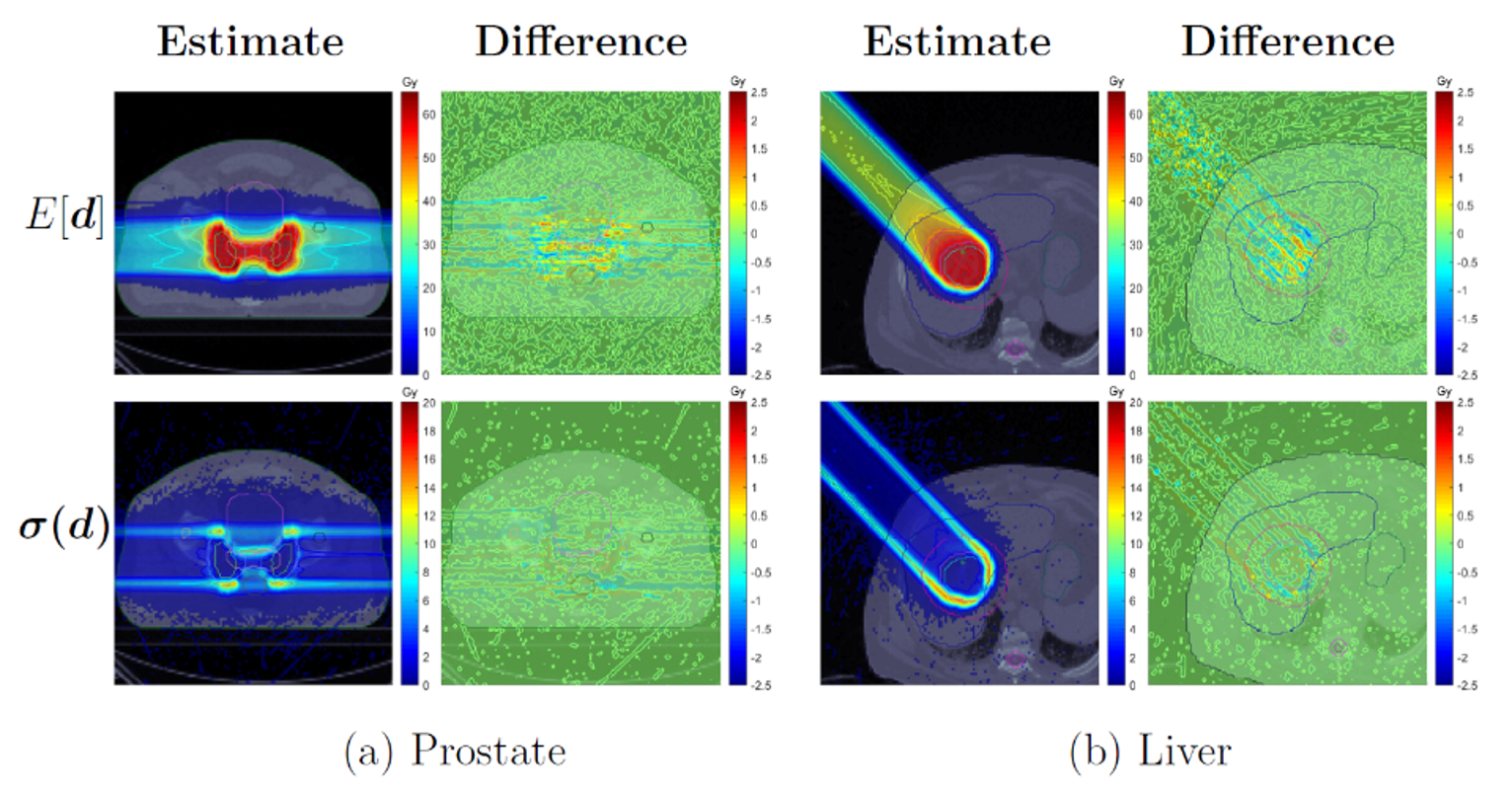
Pia Stammer, Lucas Burigo, Oliver Jäkel, Martin Frank, and Niklas WahlThe high precision and conformity of intensity-modulated particle therapy (IMPT) comes at the cost of susceptibility to treatment uncertainties in particle range and patient set-up. Dose uncertainty quantification and mitigation, which is usually based on sampled error scenarios, however becomes challenging when computing the dose with computationally expensive but accurate Monte Carlo (MC) simulations. This paper introduces an importance (re-)weighting method in MC history scoring to concurrently construct estimates for error scenarios, the expected dose and its variance from a single set of MC simulated particle histories. The approach relies on a multivariate Gaussian input and uncertainty model, which assigns probabilities to the initial phase space sample, enabling the use of different correlation models. Exploring and adapting bivariate emittance parametrizations for the beam shape, accuracy can be traded between that of the uncertainty or the nominal dose estimate. The method was implemented using the MC code TOPAS and tested for proton IMPT plan delivery in comparison to a reference scenario estimate. We achieve accurate results for set-up uncertainties (\\gamma_{3mm/3\%} ≥99.99\%\) and expectedly lower but still sufficient agreement for range uncertainties, which are approximated with uncertainty over the energy distribution (\\gamma_{3 mm/3\%} ≥99.50\% (\E[\boldsymbol{d}]\), \\gamma_{3mm/3\%} ≥91.69\% (\σ(\boldsymbol{d})\) ). Initial experiments on a water phantom, a prostate and a liver case show that the re-weighting approach lowers the CPU time by more than an order of magnitude. Further, we show that uncertainty induced by interplay and other dynamic influences may be approximated using suitable error correlation models.
- IJROBPAmit Ben Antony Bennan, Jan Unkelbach, Niklas Wahl, Patrick Salome, and Mark Bangert
Purpose: Carbon ions are radiobiologically more effective than photons and are beneficial for treating radioresistant gross tumour volumes (GTV). However, due to a reduced fractionation effect, they may be disadvantageous for treating infiltrative tumours, where healthy tissue inside the clinical target volume (CTV) must be protected through fractionation. This work addresses the question: what is the ideal combined photon-carbon ion fluence distribution for treating infiltrative tumours given a specific fraction allocation between photons and carbon ions? Methods: We present a method to simultaneously optimize sequentially delivered intensity modulated photon (IMRT) and carbon ion (CIRT) treatments based on cumulative biological effect, incorporating both the variable RBE of carbon ions and the fractionation effect within the linear quadratic model. The method is demonstrated for six Glioblastoma patients in comparison to current clinical standard of independently optimized CIRT - IMRT plans. Results: Compared to the reference plan, joint optimization strategies yield inhomogeneous photon and carbon ion dose distributions that cumulatively deliver a homogeneous biological effect distribution. In the optimal distributions, the dose to CTV is mostly delivered by photons while carbon ions are restricted to the GTV with variations depending on tumour size and location. Improvements in conformity of high dose regions are reflected by a mean EQD2 reduction of 3.29 ± 1.22 Gy in a dose fall-off margin around the CTV. Carbon ions may deliver higher doses to the center of the GTV, while photon contributions are increased at interfaces with CTV and critical structures. This results in a mean EQD2 reduction of 8.3 ± 2.28 Gy, where the brainstem abuts the target volumes. Conclusions: We have developed a biophysical model to optimize combined photon-carbon ion treatments. For six glioblastoma patient cases, we show that our approach results in a more targeted application of carbon ions that (1) reduces dose in normal tissues within the target volume which can only be protected through fractionation (2) boosts central target volume regions in order to reduce integral dose. Joint optimization of IMRT - CIRT treatments enable the exploration of a new spectrum of plans that can better address physical and radiobiological treatment planning challenges.
- Med. Phys.
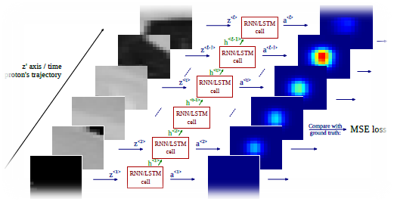
Ahmad Neishabouri, Niklas Wahl, Andrea Mairani, Ullrich Köthe, and Mark BangertPurpose: To investigate the feasibility and accuracy of proton dose calculations with artificial neural networks (ANNs) in challenging three-dimensional (3D) anatomies. Methods: A novel proton dose calculation approach was designed based on the application of a long short-term memory (LSTM) network. It processes the 3D geometry as a sequence of two-dimensional (2D) computed tomography slices and outputs a corresponding sequence of 2D slices that forms the 3D dose distribution. The general accuracy of the approach is investigated in comparison to Monte Carlo reference simulations and pencil beam dose calculations. We consider both artificial phantom geometries and clinically realistic lung cases for three different pencil beam energies. Results: For artificial phantom cases, the trained LSTM model achieved a 98.57% γ-index pass rate ([1%, 3 mm]) in comparison to MC simulations for a pencil beam with initial energy 104.25 MeV. For a lung patient case, we observe pass rates of 98.56%, 97.74%, and 94.51% for an initial energy of 67.85, 104.25, and 134.68 MeV, respectively. Applying the LSTM dose calculation on patient cases that were fully excluded from the training process yields an average γ-index pass rate of 97.85%. Conclusions: LSTM networks are well suited for proton dose calculation tasks. Further research, especially regarding model generalization and computational performance in comparison to established dose calculation methods, is warranted. © 2020 The Authors. Medical Physics published by Wiley Periodicals LLC on behalf of American Association of Physicists in Medicine. [https://doi.org/10.1002/mp.14658]
- Phys. Med. Biol.Louise Marc, Silvia Fabiano, Niklas Wahl, Claudia Linsenmeier, Antony John Lomax, and Jan Unkelbach
Objective: Proton therapy remains a limited resource due to gantry size and its cost. Recently, a new design without a gantry has been suggested. It may enable combined proton-photon therapy (CPPT) in conventional bunkers and allow the widespread use of protons. In this work, we explore this concept for breast cancer. Methods: The treatment room consists of a LINAC for IMRT, a fixed proton beamline (FBL) with beam scanning and a motorized couch for treatments in lying positions with accurate patient setup. Thereby, proton and photon beams are delivered in the same fraction. Treatment planning is performed by simultaneously optimizing IMRT and IMPT plans based on the cumulative dose. The concept is investigated for three breast cancers where the goal is to minimize mean dose to the heart and lung while delivering 40.05 Gy in 15 fractions to the PTV with a SIB of 48 Gy to the tumor bed. The probabilistic approach is applied to mitigate the sensitivity to range uncertainties. Results: CPPT is particularly advantageous for irradiating concave target volumes that wrap around a curved chest wall. There, protons may deliver dose to the peripheral and medial parts of the target volume including lymph nodes. Thereby, the mean dose in normal tissues is reduced compared to single-modality IMRT. However, tangential photon beams may treat parts of the target volume near the interface to the lung. To ensure target coverage for range undershoot in an IMPT plan, proton beams have to deliberately overshoot into the lung tissue - a problem that can be mitigated via the photon component which ensures plan conformity and robustness. Conclusion: CPPT using an FBL may represent a realistic approach to make protons available to more patients. In addition, CPPT may generally improve treatment quality compared to both single-modality proton and photon treatments.
- Med Phys
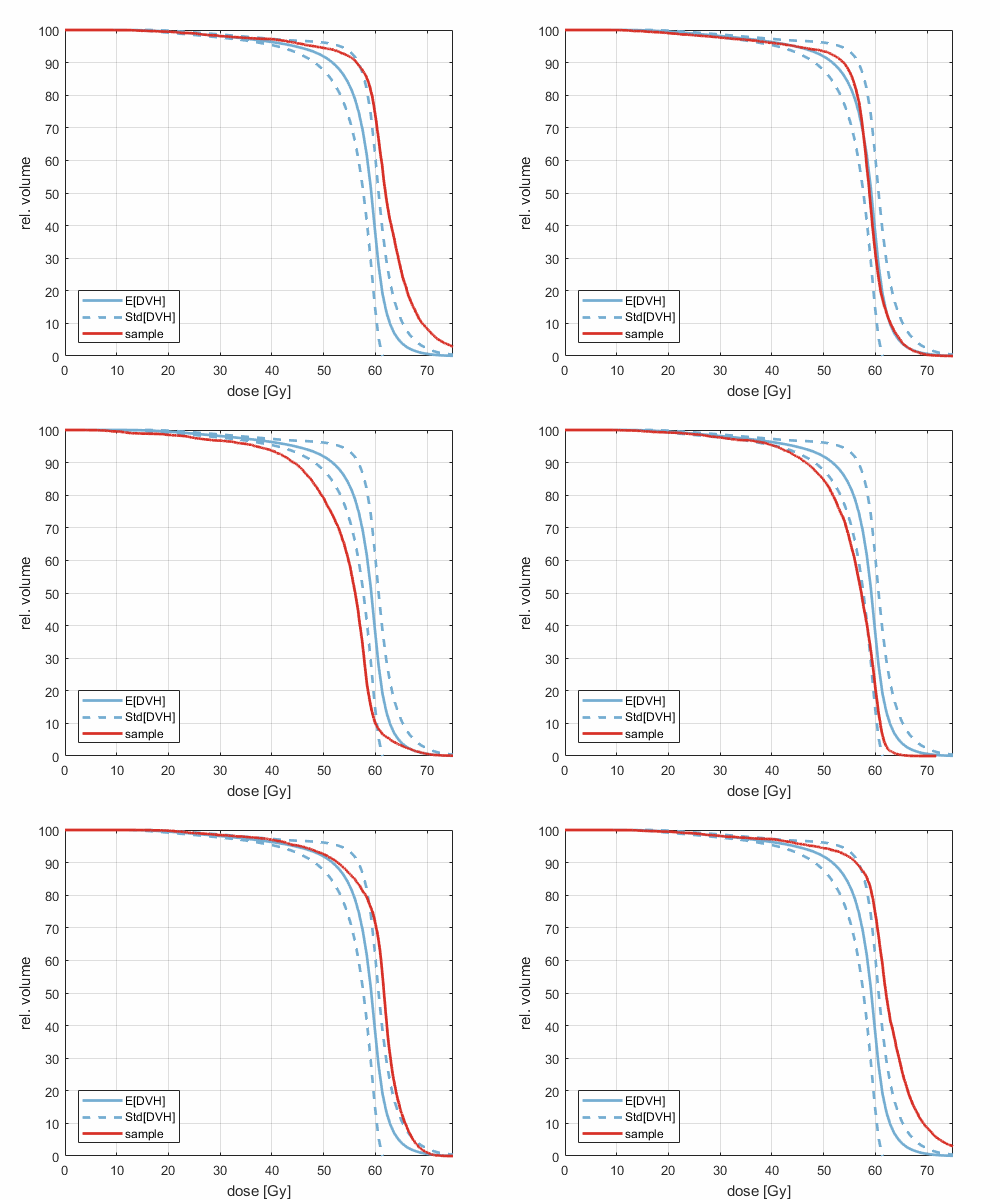
Niklas Wahl, Philipp Hennig, Hans-Peter Wieser, and Mark BangertPurpose Radiotherapy, especially with charged particles, is sensitive to executional and preparational uncertainties that propagate to uncertainty in dose and plan quality indicators, e. g., dose-volume histograms (DVHs). Current approaches to quantify and mitigate such uncertainties rely on explicitly computed error scenarios and are thus subject to statistical uncertainty and limitations regarding the underlying uncertainty model. Here we present an alternative, analytical method to approximate moments, in particular expectation value and (co)variance, of the probability distribution of DVH-points, and evaluate its accuracy on patient data. Methods We use Analytical Probabilistic Modeling (APM) to derive moments of the probability distribution over individual DVH-points based on the probability distribution over dose. By using the computed moments to parameterize distinct probability distributions over DVH-points (here normal or beta distributions), not only the moments but also percentiles, i. e., α-DVHs, are computed. The model is subsequently evaluated on three patient cases (intracranial, paraspinal, prostate) in 30- and singlefraction scenarios by assuming the dose to follow a multivariate normal distribution, whose moments are computed in closed-form with APM. The results are compared to a benchmark based on discrete random sampling. Results The evaluation of the new probabilistic model on the three patient cases against a sampling benchmark proves its correctness under perfect assumptions as well as good agreement in realistic conditions. More precisely, ca. 90% of all computed expected DVH-points and their standard deviations agree within 1% volume with their empirical counterpart from sampling computations, for both fractionated and single fraction treatments. When computing α-DVHs, the assumption of a beta distribution achieved better agreement with empirical percentiles than the assumption of a normal distribution: While in both cases probabilities locally showed large deviations (up to ±0.2), the respective α -DVHs for α = 0:05; 0:5; 0:95 only showed small deviations in respective volume (up to ±5% volume for a normal distribution, and up to 2% for a beta distribution). A previously published model from literature, which was included for comparison, exhibited substantially larger deviations. Conclusions With APM we could derive a mathematically exact description of moments of probability distributions over DVH-points given a probability distribution over dose. The model generalizes previous attempts and performs well for both choices of probability distributions, i. e., normal or beta distributions, over DVH-points.
- Phys. Med. Biol.Hans-Peter Wieser, Christian P. Karger, Niklas Wahl, and Mark Bangert
Range and setup uncertainties in charged particle therapy may induce a discrepancy between the planned and the delivered dose. Countermeasures based on probabilistic (stochastic) optimization usually assume a Gaussian probability density to model the underlying range and setup error. While this standard assumption is generally taken for granted, this study explicitly investigates the dosimetric consequences if the actual range and setup errors obey a different probability density function (PDF) over the course of treatment to the one used during the probabilistic treatment plan optimization. Discrete random sampling was performed for conventionally and probabilistically optimized proton and carbon ion treatment plans utilizing various PDFs that modeled the setup and range error. This method allowed us to assess the treatment plan robustness against different PDFs of conventional and probabilistic plans, which both explicitly assume Gaussian uncertainties. The induced uncertainty in dose was quantified by estimating the expectation value and standard deviation of the RBE-weighted dose for each PDF on the basis of 2500-5000 random dose samples. Probabilistic dose metrics and standard deviation volume histograms were computed to quantify treatment plan robustness of both optimization approaches. It was shown that the classical planning target volume margin extension concept did not compensate the influence of range and setup errors and consequently resulted in a non-negligible average standard deviation in dose of 7.3% throughout the clinical target volume (CTV). In contrast, probabilistic optimization on normally distributed errors yielded treatment plans that not only entailed a lower standard deviation against normally distributed errors accounted for during optimization, but also lower standard deviations for other symmetric PDFs. It was shown that the impact of an incorrect probability distribution assumption is of lower importance after probabilistic optimization as the average uncertainty in the CTV drops to 3.9%. Probabilistic optimization is an effective tool to create robust particle treatment plans. Normally distributed range and setup error assumptions for probabilistic optimization are a reasonable first approximation and yield treatment plans that are also robust against other PDFs.
- Med PhysNiklas Wahl, Philipp Hennig, Hans-Peter Wieser, and Mark Bangert
- Hans-Peter Wieser, Niklas Wahl, Hubert S. Gabryś, Lucas-Raphael Müller, Giuseppe Pezzano, Johanna Winter, and 4 more authors
We present educational aspects of matRad –an open-source treatment planning toolkit for threedimensional intensity-modulated radiotherapy treatment planning supporting photons, scanned protons and scanned carbon ions. matRad is publicly available for download on GitHub and does not require payable software-products to run or to change its source code. This manuscript helps new users to get familiar with the basic concept, the matRad GitHub environment, and potential applications. Specifically we discuss seven novel workflow examples that illustrate usage of matRad’s code base and we introduce three practical treatment planning examples from a planner’s point of view. The workflow examples and the treatment planning tutorial are available in the form of Matlab scripts and documented with pdf files and wiki pages, respectively. They are intended as both learning and teaching material, e.g., in a classroom setting. The provided examples range from simple to complex treatment planning scenarios and can all be executed in a couple of minutes on a standard desktop computer.
- Phys Med BiolHans-Peter Wieser, Philipp Hennig, Niklas Wahl, and Mark Bangert
- Phys Med BiolNiklas Wahl, Philipp Hennig, Hans-Peter Wieser, and Mark Bangert
- Med PhysHans-Peter Wieser, Eduardo Cisternas, Niklas Wahl, Silke Ulrich, Alexander Stadler, Henning Mescher, and 11 more authors
Purpose We report on the development of the open-source cross-platform radiation treatment planning toolkit matRad and its comparison against validated treatment planning systems. The toolkit enables three-dimensional intensity-modulated radiation therapy treatment planning for photons, scanned protons and scanned carbon ions. Methods matRad is entirely written in Matlab and is freely available online. It re-implements well-established algorithms employing a modular and sequential software design to model the entire treatment planning workflow. It comprises core functionalities to import DICOM data, to calculate and optimize dose as well as a graphical user interface for visualization. matRad dose calculation algorithms (for carbon ions this also includes the computation of the relative biological effect) are compared against dose calculation results originating from clinically approved treatment planning systems. Results We observe three-dimensional γ-analysis pass rates ≥ 99.67% for all three radiation modalities utilizing a distance to agreement of 2 mm and a dose difference criterion of 2%. The computational efficiency of matRad is evaluated in a treatment planning study considering three different treatment scenarios for every radiation modality. For photons, we measure total run times of 145 s–1260 s for dose calculation and fluence optimization combined considering 4–72 beam orientations and 2608–13597 beamlets. For charged particles, we measure total run times of 63 s–993 s for dose calculation and fluence optimization combined considering 9963–45574 pencil beams. Using a CT and dose grid resolution of 0.3 cm3 requires a memory consumption of 1.59 GB–9.07 GB and 0.29 GB–17.94 GB for photons and charged particles, respectively. Conclusion The dosimetric accuracy, computational performance and open-source character of matRad encourages a future application of matRad for both educational and research purposes.
- JACMPPhysically constrained voxel-based penalty adaptation for ultra-fast IMRT planningNiklas Wahl, Mark Bangert, Cornelis P Kamerling, Peter Ziegenhein, Gijsbert H Bol, Bas W Raaymakers, and 1 more author
peer-reviewed conference contributions
- PTCOG 63SO061 / #149 - LET based proton plan calculation with superiorization and feasibility seeking based dose mimickingTobias Becher, Yair Censor, and Niklas Wahl
- PTCOG 63O142 / #192 - Trading robustness: 4D proton planning with scenario-free multi-criteria optimization approachesRemo Cristoforetti, Philipp Süss, Tobias Becher, Jennifer Hardt, and Niklas Wahl
- PTCOG 63SO043 / #318 - Framework and Monte Carlo validation of an ion treatment planning tool employing cluster doseSimona Facchiano, Ramon Ortiz, Naoki Kondo, Remo Cristoforetti, Bruce Faddegon, Oliver Jäkel, and 1 more author
- PTCOG 63O059 / #118 - Investigation of the residual helium range and lung patient use cases in online range probing with mixed carbon-helium beamsJennifer Hardt, Alexander Pryanichnikov, Oliver Jäkel, Joao Seco, and Niklas Wahl
- PTCOG 63EV137 / #473 - Convolutional Bayesian LSTMs for multi-energy dose calculation with uncertaintyVictoria Santiago Aguilar, Lina Bucher, Luke Voss, Ahmad Neishabouri, Tim Ortkamp, Andrea Mairani, and 1 more author
- M & CPia Stammer, Tiberiu Burlacu, Niklas Wahl, Danny Lathouwers, and Jonas Kusch, Denver, CO,
Deterministically solving charged particle transport problems at a sufficient spatial and angular resolution is often prohibitively expensive, especially due to their highly forward peaked scattering. We propose a model order reduction approach which evolves the solution on a low-rank manifold in time, making computations feasible at much higher resolutions and reducing the overall run-time and memory footprint. For this, we use a hybrid dynamical low-rank approach based on a collided-uncollided split, i.e., the transport equation is split through a collision source method. Uncollided particles are described using a ray tracer, facilitating the inclusion of boundary conditions and straggling, whereas collided particles are represented using a moment method combined with the dynamical low-rank approximation. Here the energy is treated as a pseudo-time and a rank adaptive integrator is chosen to dynamically adapt the rank in energy. We can reproduce the results of a full-rank reference code at a much lower rank and thus computational cost and memory usage. The solution further achieves comparable accuracy with respect to TOPAS MC as previous deterministic approaches.
- Mark Arndt, G. Stanic, Oliver Jäkel, Kristina Giske, and Niklas Wahl
- Fan Xiao, Michael Kriechbaum, Domagoj Radonic, Niklas Wahl, Ahmad Neishabouri, Nikolaos Delopoulos, and 6 more authors
- PTCOG62Remo Cristoforetti and Niklas Wahl, Singapore,
- PTCOG 62Simona Facchiano, Ramon Ortiz, Naoki Kondo, Remo Cristoforetti, Bruce Faddegon, Oliver Jäkel, and 1 more author, Singapore,
- PTCOG 62Jennifer Hardt, Alexander Pryanichnikov, Noa Homolka, Ethan Dejongh, Don F. Dejongh, Remo Cristoforetti, and 2 more authors, Singapore,
- PTCOG 62Ruirui Lui, Sedar Charyyev, Niklas Wahl, Wei Liu, Minglei Kang, Jun Zhou, and 3 more authors, Singapore,
- PTCOG 62Tim Ortkamp, Habiba Sallem, Semi Harrabi, Martin Frank, Oliver Jäkel, Julia Bauer, and 1 more author, Singapore,
- PTCOG 62SO004 / #809 - An Open Framework for Comparing LET-Modifying Objectives in Proton Treatment PlanningLisa Seckler, Amit Ben Antony Bennan, and Niklas Wahl, Singapore,
- ESTRO 2024Mateusz Krzysztof Sitarz, Maria Grazia Ronga, Flavia Gesualdi, Anthony Bonfrate, Niklas Wahl, and Ludovic De Marzi, Glasgow, UK,
- ESTRO 2024Niklas Wahl and Remo Cristoforetti, Glasgow, UK,
- Tobias Becher, Amit Ben Antony Bennan, Remo Cristoforetti, and Niklas Wahl
We present an implementation of a Pareto plan navigation framework in the open source treatment planning toolkit matRad. It expands on the existing weighted sum approach and allows for calculation and navigation of Pareto surfaces. Furthermore we introduce a lexicographic approach as an alternative to the weighted sum method.
- Remo Cristoforetti, Philipp Salome, and Niklas Wahl
- Tim Ortkamp, Patrick Salome, Oliver Jäkel, Martin Frank, and Niklas Wahl
- Fan Xiao, Domagoj Radonic, Niklas Wahl, Luke Voss, Ahmad Neishabouri, Nikolaos Delopoulos, and 5 more authors
Objective: To present a long short-term memory (LSTM) network-based dose calculation method for magnetic resonance (MR)guided proton therapy. Approach: 30 deformed planning computed tomography (CT) images of prostate cancer patients were collected for Monte Carlo (MC) dose calculation under a 1.5 T magnetic field. Proton pencil beams (PB) at 150, 175, and 200 MeV energies were simulated (6480 PBs at each energy). A 3D relative stopping power (RSP) cuboid covering the extent of the PB dose was extracted and flattened into the LSTM model, yielding a 3D predicted PB dose. Training and validation involved 25 patients; 5 patients were reserved for testing. Results: Test results of all PBs showed a mean gamma passing rate (2%/2 mm) of 99.89%, with an average center-of-mass discrepancy of 0.36 mm between predicted and simulated trajectories. The model inference time was 10 ms per beam. Conclusion: LSTM models for proton dose calculation in a magnetic field were developed and showed promising accuracy and efficiency for prostate cancer patients.
- PTCOG 61A novel method for FLASH radiotherapy: Combining FLASH with IMRTJoão Lourenço, Joana Leitão, Niklas Wahl, Filipa Baltazar, José Marques, and João Seco, Madrid,
- PTCOG 61On the feasibility of high-dimensional multivariate machine learning model-based outcome optimization for intensity-modulated treatment planning in proton therapyTim Ortkamp, Oliver Jäkel, Martin Frank, and Niklas Wahl, Madrid,
- PTCOG 61Experimental dosimetric validation of an open-source treatment planning system for IMPT dose delivery at a horizontal PBS research beamlineCésar Sepúlveda, Benjamin Gebauer, Aswin Hoffmann, Armin Lühr, Niklas Wahl, and Lucas Burigo, Madrid,
- PTCOG 61Time and memory efficient deterministic proton dose calculations using the dynamical low-rank approximationPia Stammer, Niklas Wahl, Danny Lathouwers, and Jonas Kusch, Madrid,
- ESTRO 2023Luke Voss, Ahmad Neishabouri, Tim Ortkamp, and Niklas Wahl, Vienna, Austria,
- ESTRO 2023Niklas Wahl, Nikolaos Charitonidis, Manjit Dosanjh, Noa Homolka, Christian Graeff, Aristeidis Mamaras, and 6 more authors, Vienna, Austria,
- DPG SMuK FrühjahrstagungThe Particle Therapy Masterclass for targeted education and outreach on real-world application of fundamental physicsNiklas Wahl
- PTCOG 60Determining the number of photon and particle fractions for jointly optimized combined treatmentsAmit Ben Antony Bennan, Jan Unkelbach, and Niklas Wahl, Miami,
- PTCOG 60Towards a generalized (N)TCP optimization framework across modalities using classical and machine learning modelsJennifer Hardt, Tim Ortkamp, and Niklas Wahl, Miami,
- PTCOG 60Feasibility of proton SBRT FLASH treatment with dose, dose rate, and LET optimization using patient specific 3D ridgeRuirui Liu, Serdar Charyyev, Niklas Wahl, Wei Liu, Jun Zhou, Yang Xiaofeng, and 3 more authors, Miami,
- PTCOG 60Scenario-free probabilistic proton dose optimization using expected dose influence and total varianceNiklas Wahl and Hans-Peter Wieser, Miami,
- ESTROPia Stammer, Lucas Burigo, Oliver Jäkel, Martin Frank, and Niklas Wahl, Kopenhagen,
- vConf21Panagiota Foka, Aristeidis Mamaras, Damir Skrjiel, Joao Seco, Christian Graeff, Marco Pulia, and 2 more authors, Online,
The aim of the new Particle Therapy MasterClass (PTMC) was to develop an educational and training environment in which anyone can learn about fundamental and applied research in particle therapy. The PTMC was recently integrated into the International MasterClass 2021 online programme that attracted 1500 students from 37 institutes in 20 countries, worldwide. The PTMC focuses on the topic of cancer treatment, a particularly sensitive and socially relevant topic. The main idea is to (a) provide a basic understanding of cancer radiation therapy, (b) demonstrate that fundamental properties of particle interactions with matter, which are used for detection in physics experiments, are also the basis for treating cancer tumours; and (c) show that the same accelerator technologies are used in both, research laboratories and therapy centres. For the hands-on session, the open-source professional treatment planning software matRad is used, developed for research and training by the German Cancer Research Center – DKFZ. Ultimately, students are shown “what physics has to do with medicine” and what are the various possibilities that physics and STEM studies may open up for job opportunities in fields that are lacking expert personnel.
- PTCOG 59Degradation of particle depth dose in lung tissue: An efficient and consistent model for Monte Carlo and analytical dose calculationNoa Homolka, Paul Anton Meder, Lucas Burigo, Hans-Peter Wieser, Mark Bangert, Oliver Jäkel, and 2 more authors, Online,
- PTCOG 59Efficient uncertainty estimates in Monte Carlo dose calculation using importance reweightingPia Stammer, Lucas Burigo, Oliver Jäkel, Martin Frank, and Niklas Wahl, Online,
- ESTROLouise Marc, Silvia Fabiano, Niklas Wahl, Claudia Linsenmeier, Antony John Lomax, and Jan Unkelbach, Online,
- DGMP 2021The role of uncertainties in jointly optimised mixed carbon/photon treatmentsMartina Palkowitsch, Amit Ben Antony Bennan, and Niklas Wahl
- ESTRONoa Homolka, Hans-Peter Wieser, Mark Bangert, Malte Ellerbrock, and Niklas Wahl, Online,
- ESTROAhmad Neishabouri, Niklas Wahl, Lucas Norberto Burigo, Ullrich Köthe, and Mark Bangert, Online,
- ESTRONiklas Wahl, Hans-Peter Wieser, Lucas Burigo, and Mark Bangert, Online,
- ESTROMark Bangert, Niklas Wahl, and Hans-Peter Wieser, Milan,
- 19th ICCRDevelopment report for the open source dose calculation and optimization toolkit matRadNiklas Wahl, Edgardo Doerner, Lucas Noberto Burigo, Daniel Ramirez, Ahmad Neishabouri, Amit Ben Antony Bennan, and 2 more authors
- 19th ICCRConfidence constraints for probabilistic radiotherapy treatment planningNiklas Wahl, Philipp Hennig, Hans-Peter Wieser, and Mark Bangert
- 19th ICCRImpact of Gaussian uncertainty assumptions for probabilistic optimization considering range errorsHans-Peter Wieser, Christian P. Karger, Niklas Wahl, and Mark Bangert
- 19th ICCRClosed-form modeling of biological uncertainties in carbon ion therapyHans-Peter Wieser, Philipp Hennig, Niklas Wahl, and Mark Bangert
- ESTRONiklas Wahl, Philipp Hennig, Hans-Peter Wieser, and Mark Bangert, Barcelona,
- ESTROHans-Peter Wieser, Niklas Wahl, Philipp Hennig, and Mark Bangert, Barcelona,
- ESTRONiklas Wahl, Philipp Hennig, Hans-Peter Wieser, and Mark Bangert, Barcelona,
- 18th ICCRProbabilistic proton treatment planning using accelerated analytical probabilistic modellingNiklas Wahl, Philipp Hennig, and Mark Bangert
- 18th ICCRAnalytical probabilistic modeling of range and setup uncertainties in carbon ion therapy planningHans-Peter Wieser, Niklas Wahl, Philipp Hennig, and Mark Bangert
- PTCOG & PTCOG-NANiklas Wahl, Cornelis Philippus Kamerling, Hendrik Heinrich, Philipp Hennig, and Mark Bangert, San Diego,
Books
- Christoph Kommer, Tim Tugendhat, and Niklas Wahl, Berlin, Heidelberg,
-
Christoph Kommer, Tim Tugendhat, and Niklas Wahl, Berlin, Heidelberg, - Christoph Kommer, Tim Tugendhat, and Niklas Wahl, Berlin, Heidelberg,
Theses
- Analytical Models for Probabilistic Inverse Treatment Planning in Intensity-modulated Proton TherapyNiklas Wahl, Heidelberg,
The sensitivity of intensity-modulated proton therapy to uncertainties requires case-specific uncertainty assessment and mitigation. As an alternative to scenario-based methods, this thesis describes the implementation, application and conceptual extension of the Analytical Probabilistic Modeling (APM) framework introduced by Bangert, Hennig, and Oelfke (2013). APM represents moments of the probability distribution over dose in closed-form, providing a probabilistic analog to nominal pencil-beam dose calculation subject to range and setup uncertainties that further enables probabilistic optimization. First, APM was implemented in MITKrad, a treatment planning plugin for MITK built completely from scratch. APM’s computations were validated against sample statistics, showing nearly perfect agreement. Run-times within minutes could be realized for uncertainty assessment and probabilistic optimization on patient data. Reformulation of APM enabled linear separation of the computations into random and systematic uncertainty components. Uncertainty over the full fractionation spectrum could then be modeled and optimized with a single pre-computation. It could be shown that fractionation is exploited in optimization with APM for additional organ at risk sparing. APM was then extended to propagation of uncertainties from dose to clinically relevant plan quality metrics. Expectation and variance could be modeled accurately for organ mean dose and dose-volume histograms. However, approximations for equivalent uniform dose and minimum and maximum dose values did not provide reliable results. Finally, the closed-form plan metrics were used to conceptualize constrained probabilistic optimization. Besides novel probabilistic objectives, confidence constraints could be established. Due to increased computational complexity of the new models, the proof-of-concept was provided through evaluations on a one-dimensional prototype anatomy. In conclusion, the herein extended APM framework is able to provide probabilistic analogs to established nominal concepts of dose calculation, plan quality metrics, and constrained optimization. If computational hurdles can be overcome in the future, clinical application would be within reach.
preprints, reports and other publications
- Fan Xiao, Nikolaos Delopoulos, Niklas Wahl, Lennart Volz, Lina Bucher, Matteo Maspero, and 10 more authors
Purpose: Accurate dose calculation is essential in radiotherapy for precise tumor irradiation while sparing healthy tissue. With the growing adoption of MRI-guided and real-time adaptive radiotherapy, fast and accurate dose calculation on CT and MRI is increasingly needed. The DoseRAD2026 dataset and challenge provide a public benchmark of paired CT and MRI data with beam-level photon and proton Monte Carlo dose distributions for developing and evaluating advanced dose calculation methods. Acquisition and validation methods: The dataset comprises paired CT and MRI from 115 patients (75 training, 40 testing) treated on an MRI-linac for thoracic or abdominal lesions, derived from the SynthRAD2025 dataset. Pre-processing included deformable image registration, air-cavity correction, and resampling. Ground-truth photon (6 MV) and proton dose distributions were computed using open-source Monte Carlo algorithms, yielding 40,500 photon beams and 81,000 proton beamlets. Data format and usage notes: Data are organized into photon and proton subsets with paired CT-MRI images, beam-level dose distributions, and JSON beam configuration files. Files are provided in compressed MetaImage (.mha) format. The dataset is released under CC BY-NC 4.0, with training data available from April 2026 and the test set withheld until March 2030. Potential applications: The dataset supports benchmarking of fast dose calculation methods, including beam-level dose estimation for photon and proton therapy, MRI-based dose calculation in MRI-guided workflows, and real-time adaptive radiotherapy.
- Simona Facchiano, Ramon Ortiz, Remo Cristoforetti, Naoki D-Kondo, Oliver Jaekel, Bruce Faddegon, and 1 more author
Nanodosimetry relates Ionization Detail (ID) and ionization parameters (Ip) to biological endpoints relevant for charged-particle radiotherapy. This supports a more physics-based modeling of biological effectiveness than traditional dose-response relationships and RBE models. Faddegon et al. (2023) introduced cluster dose g(Ip) as a physical quantity, bridging ID to the treatment planning level, which can be directly optimized. We developed a framework enabling cluster dose optimization via a pencil-beam (PB) algorithm, and validated against Monte Carlo (MC) simulations. The framework, integrated into the treatment planning toolkit matRad, uses precomputed Ip values obtained from MC track-structure simulations. We applied our tool for plan optimization with protons, helium, and carbon ions in a water phantom and a prostate case. Recalculation with TOPAS showed 3D gamma passing rates >97% (phantom) and >98% (patient) using a 3%/3mm criterion and a threshold of 10% of the maximum dose. Cluster dose F5 optimization produced homogeneous target coverage, with heavier ions requiring lower absorbed doses for the same prescribed cluster dose level. This demonstrates the feasibility of fast, accurate cluster dose optimization using PB algorithms.
- Luke Voss, Ahmad Neishabouri, Tim Ortkamp, Andrea Mairani, and Niklas Wahl
We propose the BayesDose-Framework, a Bayesian approach for fast and accurate dose prediction in proton therapy. Our framework is based on a previously published deterministic LSTM model and is trained and evaluated on simulated beamlet doses from water phantoms and patient geometries. We parameterize the network’s weights using 2D Gaussian mixture models and use ensemble predictions to quantify mean dose predictions and their standard deviation. The BayesDose model performs similarly to the deterministic variant. The uncertainty predictions are conservative but correlate well spatially and in magnitude with dose differences. This correlation is reduced when applied to patient data with unseen relative stopping power value ranges, which could be successfully addressed by re-training. We parallelize predictions and presample network weights to reduce runtime overhead. Bayesian models like BayesDose can provide fast predictions with quality equal to deterministic models and may support decision making and quality assurance in clinical settings in the future.
- Pia Stammer, Lucas Burigo, Oliver Jäkel, Martin Frank, and Niklas Wahl
About ESTRO work
- Mark Bangert, Oliver Jäkel, Niklas Wahl, and Hans-Peter Wieser
DKFZ researchers developed a MATLAB toolkit that spans the entire treatment planning workflow, from setting treatment parameters and optimizing the plan to visualizing and evaluating the results.